.png)
How to Plan a Residential Landscape That Actually Lasts
- Michael Rossouw

- Mar 23
- 3 min read
Updated: Apr 15
A practical guide for Victoria and Vancouver Island homeowners—whether you hire a professional or tackle it yourself.
1. Read the Site Before You Design Anything
Every property tells you what it needs if you know where to look. Before committing to a design, understand three things: your soil, your slope, and your water.
Soil composition determines drainage behaviour. Heavy clay—common across Greater Victoria—holds water like a basin. Without amendments or engineered drainage, you’re setting up for pooling, root rot, and foundation stress. Sandy soils drain fast but struggle to retain nutrients. A basic soil test ($200–400) tells you exactly what you’re working with.
Slope and grade dictate what’s feasible. Gentle grades may only need strategic swales. Steep terrain often requires retaining walls or terracing—not just for aesthetics, but to prevent erosion and create usable space.
Existing vegetation reveals moisture levels, sun exposure, and soil pH. Native sword ferns, salal, and Oregon grape signal specific conditions. Working with what’s already thriving is almost always smarter than fighting it.
2. Design for Water Movement, Not Against It
Poor drainage destroys more residential landscapes in our region than any other single factor. Every outdoor project is also a water management project—whether you plan for it or not.

Victoria receives 600–900mm of rainfall annually, most of it between October and April. That water has to go somewhere. The goal is to direct it deliberately—away from your foundation, toward areas designed to handle it.
Practical approaches that work here:
French drains and catch basins to intercept water before it reaches problem areas
Regrading to create positive slope away from structures (minimum 2% grade for the first 3 metres)
Permeable surfaces—porous pavers, gravel, decomposed granite—that allow infiltration instead of runoff
Rain gardens and bioswales that capture and filter water naturally using native plantings
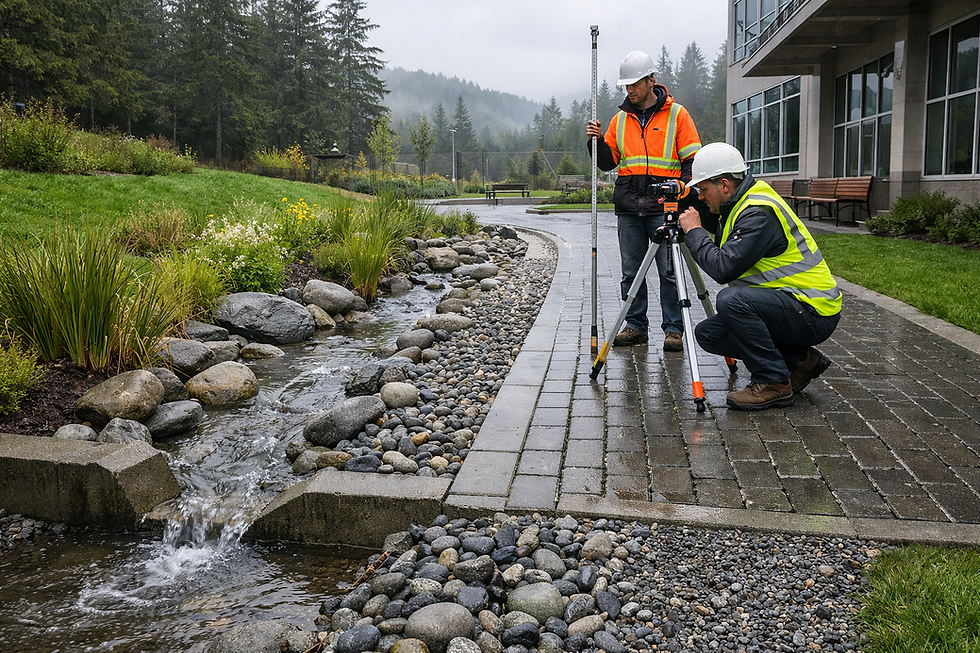
Dry creek beds that channel storm water while serving as landscape features when dry
If you only address one thing before breaking ground, make it drainage. It’s the single highest-return investment in any residential landscape project.
3. Choose Materials That Handle Coastal Conditions
Material selection drives long-term maintenance more than almost any other decision. What looks great in a showroom doesn’t always perform in a Victoria winter.
Natural stone (flagstone, basalt, granite) weathers gracefully and provides excellent traction when wet. Concrete pavers with joint gaps allow drainage and resist cracking better than solid slabs. Quality composite decking resists rot where natural wood needs replacement in 5–7 years.
The upfront premium for durable materials is typically 30–40%, but they last 3–4 times longer. Over a 15–20 year window, quality materials cost significantly less.
4. Plant for the Climate, Not the Catalogue
Native and climate-adapted plants reduce watering, fertilizing, and replacement costs dramatically once established. They also stabilize soil, support local ecosystems, and handle our wet–dry seasonal swing without intervention.
Group plants by water needs—a principle called hydrozoning. Drought-tolerant species in one zone, moisture-loving plants in another. This prevents overwatering some while underwatering others, and it simplifies irrigation if you add it later.
Layered plantings—canopy trees, understory shrubs, perennials, and groundcovers—mimic natural ecosystems. They create year-round structure, suppress weeds, and look better as they mature rather than worse.
5. Build a Realistic Schedule Around Real Constraints
Projects stall when the schedule ignores Vancouver Island’s realities. Our wet season runs October through April—excavation, grading, and paving perform best in dry months. Planting succeeds year-round but establishment rates improve in spring and fall.
Material lead times matter too. Natural stone, specialty pavers, and custom elements can take 6–12 weeks to arrive. Factor in site access—a rear yard accessible only through a narrow side gate changes equipment options, labour hours, and sequencing.
Build 15–20% buffer time into any outdoor project timeline. That’s not padding—it’s acknowledging that coastal weather and supply chains don’t follow ideal timelines.

Next Step
If your project is in the planning phase, the highest ROI move is getting the site conditions and drainage plan right before construction begins. That’s where most “surprise costs” are born, and where durable projects are made.
Ready to build it once and build it right? Schedule your assessment today.

Comments