.png)
Thinking About Hardscaping Your Yard? Here’s Where to Start in Victoria.

What every Victoria homeowner should understand about rainfall, slope, and budget before getting their first quote—whether you’re ready to build now or just exploring the idea.
If you’ve been walking your property lately and thinking about a new patio, a retaining wall, or finally fixing that boggy section of the backyard, you’re in good company. Spring is when most Victoria homeowners start mapping out outdoor projects—and it’s also when the gap between a smart project and an expensive lesson gets decided.
Hardscaping—the built elements of your landscape like patios, walls, walkways, and drainage—isn’t something most people do twice. Done right, it lasts decades. Done wrong, it shifts, cracks, pools water, and eventually gets torn out and rebuilt. The difference is rarely about who installed it. It’s about what got planned before anyone showed up with a shovel.
This guide is for homeowners who want to understand the basics before talking to a contractor. Whether you hire someone next month or three years from now, knowing these fundamentals will save you money and frustration.
1. Start With the Rain (Yes, Really)
Victoria’s wet season runs from roughly October 10 to April 21, with November averaging about 6.4 inches of rainfall. July, by contrast, averages 0.6 inches. That ten-fold difference between our wet and dry months is the single most important factor in any hardscape project on the South Island.
What this means practically: every patio, every retaining wall, every walkway is also a water management decision. A surface that doesn’t drain becomes a skating rink in January. A wall built without backfill drainage becomes a leaning hazard within a few years. A pathway without a slight crown turns into a puddle every time it rains.
Before any visible work happens, your project needs to answer one question: where does the water go? If a contractor doesn’t walk your property and talk about drainage before they talk about materials, that’s a flag worth noting.

2. Understand the Real Budget Range
Many homeowners are surprised when their first quote comes in higher than expected. That’s usually because online cost calculators don’t reflect what hardscaping actually costs in Greater Victoria.
Local pricing data places mid-range residential hardscape projects in Victoria at roughly $10,000 to $20,000. That range typically covers a paver patio, a set of stairs, a retaining wall up to about three feet, lighting, and a fire pit feature. Once a project includes structural elements like load-bearing walls or significant grading, it crosses into real construction-budget territory rather than a weekend garden refresh.
Retaining walls specifically are often priced by square foot of wall face. In the Victoria area, well-built walls typically run $35 to $75 per square foot, with access, slope, load-bearing requirements, and wall height all influencing the final number. A small garden wall might be a few thousand dollars total. A larger wall with integrated stairs can climb into the mid-teens.
Knowing these ranges before you start collecting quotes lets you have a realistic conversation. It also helps you spot quotes that are unusually low—which often means corners are being cut on base preparation or drainage.

3. Know Your Site (Before Anyone Else Does)
Site complexity is the variable most homeowners underestimate. Two identical patios on two different properties can have completely different price tags depending on:
Access — can equipment drive directly to the work area, or does material need to be hand-carried through a narrow side gate?
Slope — is the site flat, or does it need grading, terracing, or retaining structures?
Soil — is it well-draining, or is it the heavy clay common across much of Greater Victoria?
Existing utilities — are there irrigation lines, electrical conduits, or drainage tiles to work around?
Removal needs — is there an existing patio, deck, or structure that has to come out first?
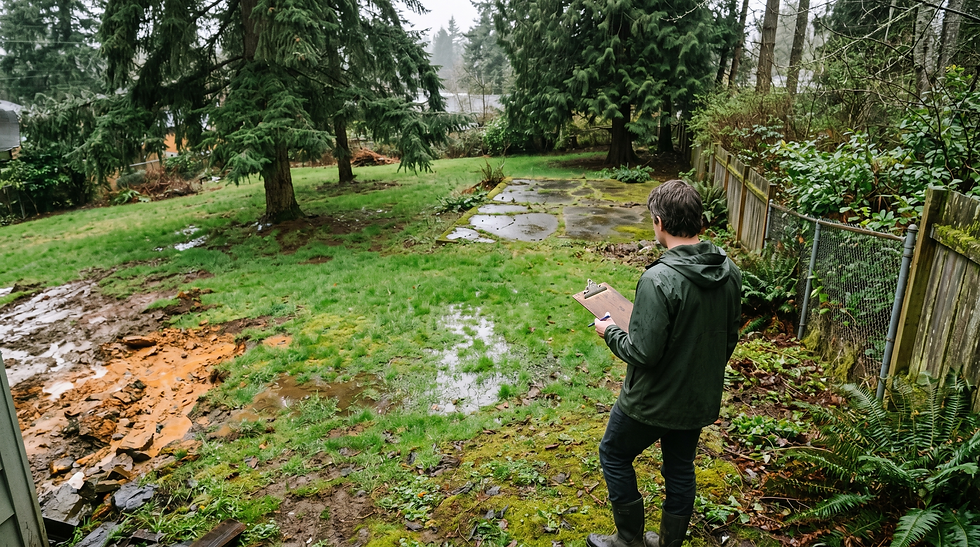
You don’t need to be an expert on any of these, but spending an afternoon walking your property with these questions in mind will make every contractor conversation more productive. You’ll also catch any quote that skips the site walkthrough—because no one can give you an accurate price without standing on your property first.
4. What to Ask Before You Hire Anyone
If you’re ready to start collecting quotes, a good conversation with a hardscape contractor should cover four things. If they can’t answer these clearly, keep looking.
How will you handle drainage? The answer should reference your specific site, not generic principles. They should be able to point at where water will move and explain how the design accommodates it.
What’s the base preparation? For pavers, you want to hear about excavation depth, gravel base, and compaction. For walls, you want to hear about footings, drainage rock, and backfill. “We install over the existing surface” is rarely the right answer in Victoria.
What’s included and what’s extra? A clear quote separates materials, labour, site prep, drainage, and contingency. Lump-sum quotes make it nearly impossible to compare bids fairly.
Can I see something similar you’ve built locally? Photos help, but a project you can drive past tells you how the work has held up. Anyone with a local track record will be glad to point you at examples.
5. When to Start Planning
Most homeowners reach out when they’re ready to start. The smarter approach is to begin the conversation a season earlier. Spring and summer are peak construction months on the Island, and the best contractors are often booked weeks or months in advance.
If you’re thinking about a project for next summer, fall is the ideal time to walk the site, get assessments, and lock in a build window. It also gives you the wet season to observe how water actually moves on your property—which informs design decisions you can’t make in dry July.
Next Step
If your project is in the planning phase, the highest ROI move is getting the site conditions and drainage plan right before construction begins. That’s where most “surprise costs” are born, and where durable projects are made.
Ready to build it once and build it right? Schedule your assessment today.

Comments